The current trend in most educational circles is incorporate more technology into the classroom. While many teachers are redesigning their lessons to include technology, they are often losing the core processes of student learning, active involvement. Sharing ideas on google docs, blogging on Seesaw, even using Audioboom for podcasting are all great tools that do not distract from learning but enhance it. But alone an active learning environment they are not. I think sometimes as educators we place too much emphasis on digital learning.
Digital learning should follow alongside hands on learning. Students should use their hands to create and design as much as they do to type and web quest. Rather than use online clip art or drawing programs why not have students hand draw or even make a model from play-doh or other materials. Rather than have a table of ipads and laptops alone also have a table full of art supplies and trinkets that students can use to innovate and build as with a makerspace.
Tinkering is one of the best ways to learn because not only are you simply playing and designing using all of your creative facets you are also using higher order and problem solving skills. Linking the analytical and the creative parts of your brain. It is providing an opportunity for students to find something relevant and interesting and rather than simply take notes or read an article they get to see the big picture and mold their own learning.
Digital learning is a great 21st century skills application. The world is technology driven and those skills are important to know and implement. However, using our digits in hands-on kinesthetic, tactile learning experiences bridges the gap between macro learning and micro learning. Allowing the big picture to be reformatted for the individual screen. When students feel they have a choice digital or digits and are provided with a creative space and opportunity they will take ownership of their learning and they will find a balance between the two.
Tuesday, October 4, 2016

Monday, October 3, 2016
Texas Quiz Bowl Alliance: A First Time Success Story
Last Saturday was our first time competing in Texas Quiz bowl Alliance. This is a quiz bowl competition encompassing all subjects. There were 32 teams competing and the top 8 qualified for Nationals which will be in Dallas in May. It was a great day. Beckendorff took two teams one placed 22nd while the other made it into the finals. Our team came in 2nd place overall defeating many challenging teams along the way. We were only 1 of three public schools in the competition. Our school is very proud and I am so happy that our team made Nationals. Now we need to try to qualify the rest of our students. In order to do that we need to go to other regional competitions and the same team needs to compete and qualify again in order for other team members to qualify. This is going to be challenge but I know we can do it.
We have 6th grade teams that will be competing on November 5th and 7/8 grade teams competing on December 10th. If we do not qualify there we have two other chances to do so. This was such a fun experience-I know myself and my students are hooked for life. It is a lot of information to study and practice but in the end, after practicing for three weeks over the summer, we came together and made it our first time out. It is the story of the underdogs coming from behind and winning. We may not have taken 1st but 2nd is just as good for these new comers.


Sunday, October 2, 2016
Mind the Gap

This phrase has come to be known as the London Underground warning message to make sure to step over the gap between the train and the platform. It is also a a consortium of 5 partners from the UK, Netherlands and Spain who are all committed to promoting & teaching Science, Engineering, Technology and Maths subjects (STEM) and are passionate about addressing the ongoing skills gap in the sector within the EU and especially the shortfall of women & increasing STEM drop-out rates of girls.
For me however, it means be cognizant of the gaps in education, social interaction, study habits and even socio-economics of our students. To not just make an assumption that our students come from stable homes, or supportive families, and that they have food on the table every night. We need to listen and interact and communicate with our students on a daily basis to guarantee that every student has a narrow gap if any. That every student feels safe and comfortable discussing their circumstances. To make sure that every student has what they need to be successful in school but also in life.
Mind the Gap, notice it, do not simple step over it as the thousands of Londoners have taught themselves to do on a daily basis. As a teacher do not just go with the flow and adjust but identify and solve. Look at every student as a new stop on the education train. You want to look out the windows and see the landscape and become familiar with your route. That way overcoming challenges will be easy and if ever the train is forced to reroute you can find your way home.
Saturday, October 1, 2016
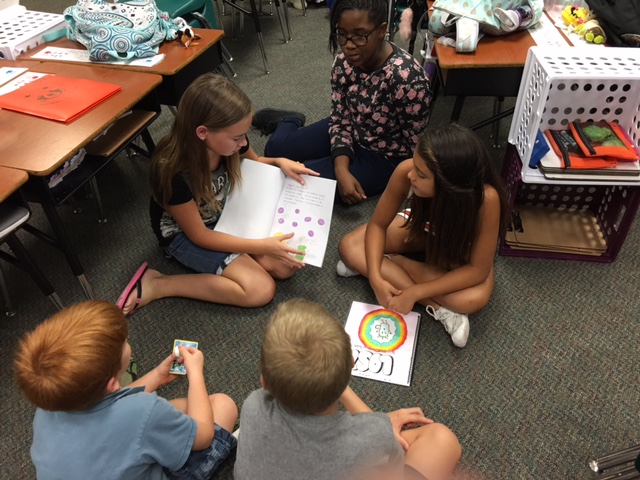
An Afternoon at An Elementary School: Community Involvement PBL
The PBL or Problem-Based Learning activity that 7th grade science decided to begin the year with was Cells. To make the topic of Cells more accessible to students we decided to have them write a children's book. They were given a storyboard sheet, a rubric, and daily guidance to help them understand the content fully before incorporating it into their books. The research was there main task, but mini-lessons were provided to enhance their knowledge and help clarify and confusion.
Students were given a list of organelles that they were responsible for knowing. They defined both structure and function of each organelle and made analogies between cells and the human body, a house, or even a school.
After three-weeks of collaborative writing, drawing, and designing the books were finished. Students were given back the rubric with their grades. The top books in each class, decided by me and my 1st grader were chosen to be taken to the elementary school, read to the 1st graders and donated to their classroom libraries. This day was yesterday. 100 7th grade students entered 4 1st grade classroom and the fun began. It was an amazing day!




Friday, September 30, 2016
Zen and the Art of Teaching
Teachers are mocked: Bad Teacher, The Substitute, and Summer School, even Ferris Buellers’ Day Off depicted teachers as slow and out-of-touch. Filmatic teachers’ speak in monotone voices or screaming echoes. Hardly ever, are they portrayed as “real people.” We are real people actually with real families and real problems, and real personalities. If ever we get a glimpse of a realistic educator their circumstances concern inner city gangs or minority racism. Which of course are great stories of diversity and strength but hardly indicative of most teachers. I have worked at three schools in my ten years of teaching, all of them different, all of them unique. Each one of them changing me as a person and teacher. Each one setting the ground work for me to become the teacher I am today. I didn’t work in East L.A. or the Bronx, or even Detroit. My students were challenging, funny, frustrating, demanding, and rebellious. But also, my students were inspiring, humbling, and remarkable. This is why the politics of teaching, the gossip, back-stabbing of faculty, and discouragement of administration can be overcome. This is why I am a teacher.
Thursday, September 29, 2016
A Makerspace: How to Incorporate it into Your Classroom: Organic Compounds Posters
The makerspace in my classroom is used almost daily. Students used it last week to design organic compounds posters. These posters were the culminating activity after students were taught about the 4 types of organic compounds and what makes up organic compounds. After the direct instruction was finished, videos watched, and labs completed, I wanted students to create a poster, they could share with the class, of all the information in this unit.
When students created these posters, they had already used the makerspace several times and were well-prepared to chose supplies and design.The entire makerspace was open to students, rather than just going to play-doh as with the giant cells, students were more adventurous and chose random supplies found below in the cardboard boxes. Noodles, beans, buttons etc. were chosen to create the posters.
Students had one entire class period of 50 minutes to research and collaborate to determine how their poster was going to look. The second day they were given 20 minutes to complete the poster, noodles and all. Finally, the rest of the class period students shared their posters with the class. Then they placed some of them on the interactive word wall for all to see.
I gave students the information I wanted to see on their posters, but how they added it was their own choice. 1-What are the 4 types of organic compounds 2-What are all organic compounds made of? (elements) 3-Explain why something is organic or inorganic. As students shared their posters we discussed their accuracy and discussed how if needed, they could have been more clear on their definitions. Feedback was instant.
There were no management issues as my classes have been working collaboratively with the makerspace since the first week of school.


When students created these posters, they had already used the makerspace several times and were well-prepared to chose supplies and design.The entire makerspace was open to students, rather than just going to play-doh as with the giant cells, students were more adventurous and chose random supplies found below in the cardboard boxes. Noodles, beans, buttons etc. were chosen to create the posters.
Students had one entire class period of 50 minutes to research and collaborate to determine how their poster was going to look. The second day they were given 20 minutes to complete the poster, noodles and all. Finally, the rest of the class period students shared their posters with the class. Then they placed some of them on the interactive word wall for all to see.
I gave students the information I wanted to see on their posters, but how they added it was their own choice. 1-What are the 4 types of organic compounds 2-What are all organic compounds made of? (elements) 3-Explain why something is organic or inorganic. As students shared their posters we discussed their accuracy and discussed how if needed, they could have been more clear on their definitions. Feedback was instant.
There were no management issues as my classes have been working collaboratively with the makerspace since the first week of school.


Wednesday, September 28, 2016
A Makerspace: How to Incorporate it into Your Classroom: Giant Cells
The makerspace in my room is used for many different things. This particular task- a group effort, was designed to make a giant cell. Each table was given an organelle. They had to research what that organelle did in the cell and create a simple model out of play-doh or any other makerspace material. They completed this task in a group of 3-4.
This was an explore activity after students had begun writing their children's books on cells. Students had already created analogies for each of the organelles, drawn and labelled both plant and animal cells, and were quizzed on the different types of cells including prokaryotic and eukaryotic cells.
The makerspace in my classroom is stocked with every art supply imaginable from glue, paper, buttons and of course various colors of play-doh. I set out various colors and they chose what colors to make each organelle. They also had a choice of anything in the makerspace. I also provided the giant paper, I went to the supply room and tore off giant butcher paper in various colors.
This was a three-part assignment. Each was 20 minutes in a 50 minute class period. Each day after the twenty minutes students worked on their children's books. Day one students researched their organelle and determined what it would be made of and look like. Day two students went to the makerspace chose their construction materials and created their organelle. Day three they each shared their organelle with the class, wrote their description of both structure and function on the paper and set their organelle in the class giant cell.
I walked around and talked to the students as they were constructing their model to just make sure they were on the right track. But, I offered no assistance in the research, design or creation of the mini-project. Feedback was immediate, after they shared with the class I asked them why they designed the organelle the way they did and offered constructive positive feedback.
In this type of project, it is all in class, at designated times, and collaborative. This was the first large makerspace activity my students have done this year. I had already modeled proper behavior, clean-up procedures, and collaborative group responsibilities. My students are up and about all the time. The community goals we have set in place have designed a classroom of respect and every student completed the task and shared their designs. The lesson was engaging because they were given a simple task and the choice of design and creation was completely by choice.
At the end as a class we discussed how all the organelles work together as a whole, why cells are so important and why making models is often the best way to study science, especially microscopic cells.


This was an explore activity after students had begun writing their children's books on cells. Students had already created analogies for each of the organelles, drawn and labelled both plant and animal cells, and were quizzed on the different types of cells including prokaryotic and eukaryotic cells.
The makerspace in my classroom is stocked with every art supply imaginable from glue, paper, buttons and of course various colors of play-doh. I set out various colors and they chose what colors to make each organelle. They also had a choice of anything in the makerspace. I also provided the giant paper, I went to the supply room and tore off giant butcher paper in various colors.
This was a three-part assignment. Each was 20 minutes in a 50 minute class period. Each day after the twenty minutes students worked on their children's books. Day one students researched their organelle and determined what it would be made of and look like. Day two students went to the makerspace chose their construction materials and created their organelle. Day three they each shared their organelle with the class, wrote their description of both structure and function on the paper and set their organelle in the class giant cell.
I walked around and talked to the students as they were constructing their model to just make sure they were on the right track. But, I offered no assistance in the research, design or creation of the mini-project. Feedback was immediate, after they shared with the class I asked them why they designed the organelle the way they did and offered constructive positive feedback.
In this type of project, it is all in class, at designated times, and collaborative. This was the first large makerspace activity my students have done this year. I had already modeled proper behavior, clean-up procedures, and collaborative group responsibilities. My students are up and about all the time. The community goals we have set in place have designed a classroom of respect and every student completed the task and shared their designs. The lesson was engaging because they were given a simple task and the choice of design and creation was completely by choice.
At the end as a class we discussed how all the organelles work together as a whole, why cells are so important and why making models is often the best way to study science, especially microscopic cells.


Subscribe to:
Posts (Atom)