This is the lesson my students remember every year and yet it is a simple one. We discuss types of camouflage: concealing coloration, disruptive coloration, disguises, counter shading, and mimicry. The students decide which one might be more favorable in different biomes. Then I have them a white butterfly and say- use which ever type of camouflage you want, color at least 2-3 colors and blend your butterfly anywhere in the room. The first day is getting every student to design and hide a butterfly. Then the second day we hunt.
Fist students stand on chairs and hunt from their seats looking around the room, counting how many they find. Then they lie on the ground and do the same thing. Basically a birds eye view and a lizards view. Then I have them sit in their chairs, close their eyes, and imagine one, only one they found. Then go and stand by it, putting their finger on it: claiming it as their snack. Then they remove it from the wall. We place all butterflies on the door in one large pack- it looks awesome. Slowly throughout the day they disappear one by one. Last butterfly standing or blending I should say wins. A king sized candy bar for the student who remains hidden the longest.
It is funny because often it is the most obvious one that remains. They tend to go for the well hidden ones first. This is a great easy way to build a healthy competition but also get students up and moving. Here are a few of the creative ones.
Tuesday, February 7, 2017
Monday, February 6, 2017
Podcasting in the Classroom: Purpose, Pronunciation and Perspective
Learning is something that should never be sedentary. Mobility and active learning is key in any classroom. Lectures, notes and classroom discussions with peers can all be uploaded and listened to as needed. Students now have accessibility to the classroom anywhere. They should not merely be the listeners of content but the recorders and creators of the dialogue as well. Getting students interested in pod-casting can be a challenge, it may seem like more work. But if you sell it as a radio drama, a personal journey of expression and knowledge, sharing ideas can be exciting, even for the quietest of students. Making eye contact is difficult for many students especially those with autism: my son being a student with autism, I recognize this every day. When he is given the option of recording his notes or presentation he is engaged and excited. A few simple alterations: privacy to edit, record, and share, bringing in humor, personal interest, passions and relevance all make a difference to many students. Even with the boisterous, outgoing, students pod-casting is helpful because it helps focus them and gives them time to formulate their ideas and create a personalized package of performance laden information.
After having students podcast I have seen many positive changes in my students. Students have the chance to listen to other students' podcasts and learn from one another. Podcasts hold their attention much better then a student standing up in class. Why? Less distractions and student recordings are much more focused. Students listen to various podcasts multiple time helping them conceptually understand the content better. I had a quiz after having students share their ideas on the topic of Charles Darwin. They scored in the middle range of mastery. Then I had students listen to each others podcasts on the topic, read each others blog posts, and I gave them a different but more challenging quiz (deeper understanding) and they all mastered the quiz. Less distractions and the ability to listen multiple times helped them conceptually see the "big picture" they other wise might have missed.
It is important to have multiple options in which students can share their ideas: 2-minute expert segments, This is what I know about.....review segments 1-2 minutes, and I can't wait to tell you what I learned segments 2-4 minutes. Maximum podcast should be five minutes. I also allow them and actually prefer sometimes for students to add a podcast behind a google slide show or a vod-cast PSA or genius hour like segment. I enjoy watching their slides or video as they discuss topics of relevance. They often come to me and ask if they can record a podcast. I put them on Canvas and all students have access to them. I am working on setting up a podcast channel on You Tube or AudioBoom. This will be the best way to make these podcasts public. Students have been perfecting their technique and now I think going public will be worthwhile.
Podcasting both by teachers: recording notes and lectures are a great toll to keep the classroom mobile and interactive. Also by creating podcasts I guide students to find purpose, model pronunciation throughout their recording and show them my personal perspective on a topic. Then I ask them to record their own podcasts showing their perspectives. The more podcasts they make (not all get posted for everyone to hear) the more practice they get. The more comfortable they feel the more humorous and exciting the podcasts become. The more they listen the more they hear flow, tone, clarity. The more they critique the more they find their own voice. Once they find their voice the more interesting and creative their podcasts become.
Podcasts are a tool for students to find personalized learning experiences. They can listen and learn on the go, but they also can contribute to the classroom community by sharing their own ideas and point of view. The more points of view, opinions, and arguments they hear the more their own become focused. Purpose is key, students need to understand why they are learning a particular content, they need to see the relevance and importance of new information. Speech and debate are an important part of the real world, getting your point across quick and concisely are skills every students needs. Podcasts allow students to learn pacing, pronunciation and flow. How to be clear and concise without an audience to guide visually. Words need to be chosen carefully and expression needs to be upbeat and engaging. Lastly, perspective is crucial in any performance, with out a focused agenda, goal, script any podcast will lose momentum and ultimately audience. These are all reinforced through student created podcasts.
After having students podcast I have seen many positive changes in my students. Students have the chance to listen to other students' podcasts and learn from one another. Podcasts hold their attention much better then a student standing up in class. Why? Less distractions and student recordings are much more focused. Students listen to various podcasts multiple time helping them conceptually understand the content better. I had a quiz after having students share their ideas on the topic of Charles Darwin. They scored in the middle range of mastery. Then I had students listen to each others podcasts on the topic, read each others blog posts, and I gave them a different but more challenging quiz (deeper understanding) and they all mastered the quiz. Less distractions and the ability to listen multiple times helped them conceptually see the "big picture" they other wise might have missed.
It is important to have multiple options in which students can share their ideas: 2-minute expert segments, This is what I know about.....review segments 1-2 minutes, and I can't wait to tell you what I learned segments 2-4 minutes. Maximum podcast should be five minutes. I also allow them and actually prefer sometimes for students to add a podcast behind a google slide show or a vod-cast PSA or genius hour like segment. I enjoy watching their slides or video as they discuss topics of relevance. They often come to me and ask if they can record a podcast. I put them on Canvas and all students have access to them. I am working on setting up a podcast channel on You Tube or AudioBoom. This will be the best way to make these podcasts public. Students have been perfecting their technique and now I think going public will be worthwhile.
Podcasting both by teachers: recording notes and lectures are a great toll to keep the classroom mobile and interactive. Also by creating podcasts I guide students to find purpose, model pronunciation throughout their recording and show them my personal perspective on a topic. Then I ask them to record their own podcasts showing their perspectives. The more podcasts they make (not all get posted for everyone to hear) the more practice they get. The more comfortable they feel the more humorous and exciting the podcasts become. The more they listen the more they hear flow, tone, clarity. The more they critique the more they find their own voice. Once they find their voice the more interesting and creative their podcasts become.
Podcasts are a tool for students to find personalized learning experiences. They can listen and learn on the go, but they also can contribute to the classroom community by sharing their own ideas and point of view. The more points of view, opinions, and arguments they hear the more their own become focused. Purpose is key, students need to understand why they are learning a particular content, they need to see the relevance and importance of new information. Speech and debate are an important part of the real world, getting your point across quick and concisely are skills every students needs. Podcasts allow students to learn pacing, pronunciation and flow. How to be clear and concise without an audience to guide visually. Words need to be chosen carefully and expression needs to be upbeat and engaging. Lastly, perspective is crucial in any performance, with out a focused agenda, goal, script any podcast will lose momentum and ultimately audience. These are all reinforced through student created podcasts.
Sunday, February 5, 2017
Blogging in the Classroom: Is it a Game Changer?
Open reflection, collaboration, peer interaction, developing literacy and writing skills, giving students a route to finding their own voice are just a few reasons why student blogging is important. Anytime students are held accountable through an open medium like blogging their focus and mindset changes. Providing opportunities where they feel safe to express their opinions helps students create a positive social media footprint, it teachers them responsibility and self-moderation. It also gives those students who are quiet in class a platform where they feel comfortable sharing their ideas and opinions.
I think the best thing for me as a teacher is to have an archive of learning. I go back and reread my own blog posts and it is astonishing how much I have changed and grown throughout the year. For students it is the same realization. What they may have believed in January may be altered and more suited for them in August. By having an open archive both of us can go back and notice trends and areas where more attention is needed. I have struggled this year getting a class blog off the ground. My focus was on my own. I tried different platforms never liking them because they were difficult to edit or access. But I found one and it was right under my nose the whole time.
Canvas is the online tool my district uses for students to access all their class material, see a calendar of all their upcoming assignments in all their classes in one place. A unity of curriculum. I use it a lot already: quizzes, test reviews, weekly discussion questions, notes, now I have another way to incorporate it in my classroom: blogs. This last Thursday I assigned the first blog post. It came out great. It was a directed post-not open ended in order to make sure they had access, understood the format, and made it stream-lined. Every student replied to my question and then replied to at least one other person- this created a great stream of posts for each level to read. I have three groups in Canvas: Academic, PreAp, and GT, this made the GT stream huge with a lot of comments about 120 students to be exact. So it was lengthy. This I may change by breaking up my GT classes (4) into smaller classes. But maybe not I do like the huge thread.
There was also recently added a podcasting ability. So I asked my students to try and send a podcast if they were interested. I saw on the thread about 25 podcasts. So now I know it works and this will be our platform for those too. Then I will take the best ones and add them to our You Tube channel. I am excited to take this further. Blogging is so important because it connects my classes together, builds a community, and provides every student a voice, a place to share ideas, and a feeling of unity with their peers.
Is blogging a game changer? I believe it is, because it is personal, reflective, and collaborative at the same time. Students have ownership of their responses and can also read other perspectives and get a great sense of the community through written and spoken word. I am just a little bummed I didn't take the leap earlier. But sometimes we need to take a chance to hold on and let other things take precedence. Other things come first. But all lead to the same place, student learning, growth and acceptance.
Saturday, February 4, 2017
Collaborative Adaptations Word Wall: A Brief Lesson in Adaptations
Every organism has a unique biome within which it lives. Aquatic or terrestrial. This eco-region is its natural habitat. This location is where the basic needs of the organism are met: food, water, shelter from the weather and place to breed its young. All organisms need to adapt to their habitat to be able to survive, reproduce and continue to keep their species alive.
Organisms adapt to survive the climatic conditions of the ecosystem, survive against predators, and other species that they compete with for the same food and space. An adaptation is a modification or change in the organism's body or behavior that enables it to survive against all odds. These slow changes, over time allow the favorable traits to be passed on and accumulate in a population while the less favorable traits slowly disappear. Charles Darwin noticed these variations among organisms of the same species and developed his theory of Natural Selection.
An animal may adapt to its habitat in different ways. It may be a physical or structural adaptation, just as the limbs of birds have modified into wings or the way the cheetah is shaped for running at a fast speed. Even a plants spikes or thorns are physical adaptations. Adaptations may also be physiological in the way the body works in circulating and respiration, for instance the gills that fish have enable them to breathe in water.
Organisms adapt to survive the climatic conditions of the ecosystem, survive against predators, and other species that they compete with for the same food and space. An adaptation is a modification or change in the organism's body or behavior that enables it to survive against all odds. These slow changes, over time allow the favorable traits to be passed on and accumulate in a population while the less favorable traits slowly disappear. Charles Darwin noticed these variations among organisms of the same species and developed his theory of Natural Selection.
An animal may adapt to its habitat in different ways. It may be a physical or structural adaptation, just as the limbs of birds have modified into wings or the way the cheetah is shaped for running at a fast speed. Even a plants spikes or thorns are physical adaptations. Adaptations may also be physiological in the way the body works in circulating and respiration, for instance the gills that fish have enable them to breathe in water.
Finally an adaptations may be behavioral which tends to be traits that are acquired by the organism after birth, such as migration, living in herds or packs, even burrowing to escape the midday sun.Or it may be the way the animal behaves whether it is hunting for food, or running fast to avoid predators or migrating to other places for food or survival.
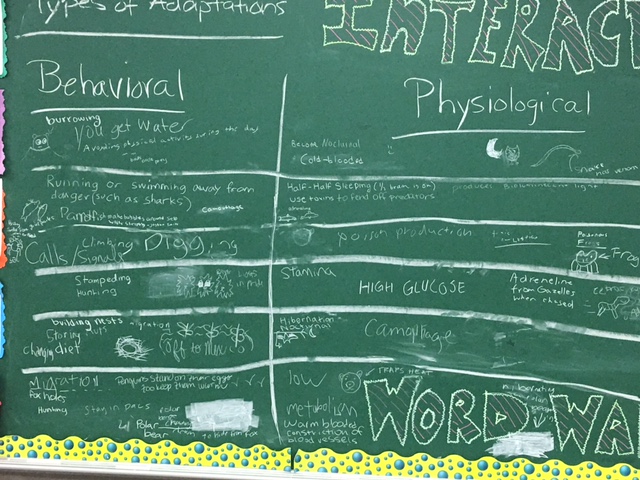
Before researching these adaptations students began to fill out the board with examples both written and drawn. Then slowly over two days they added examples and began to see the full picture of how behavioral, physiological and physical traits can be unique to one ecosystem or can overlap. There are many traits you find in every biome on Earth. Creating a giant chart (still displayed) is allowing students to modify as they continue to learn and grow as a class.
Friday, February 3, 2017
A Birds Eye View: Peppered Moth Activity
Black Peppered Moths in the 1800's were a familiar sight in England. The peppered moths that naturalists observed all looked similar and were usually found on lichen-covered tree trunks and rocks. Then, in 1845, one black specked moth was captured. This was the beginning of the industrial revolution in England. Because of the pollen, soot, and smoke from all the factories, the countryside became black and covered in ash.During this time more and more black peppered moths were found and the lighter peppered moths slowly declined. By 1950, very few light-colored moths could be found. They were easier to spot on the now soot covered surroundings leaving them ope for predation. The dark moths survived and now they are the common peppered moth species in England.
There are a lot of activities on line about this. http://www.biologycorner.com/worksheets/pepperedmoth.html as just one example of a virtual simulation. But I wanted to spice it up this year and have students use paper dots and newspaper to simulate live the predator prey circumstances of these moths. From a birds eye view so to speak. Of course they went in to it thinking this is easy. A pair of tweezers, thirty white and 30 speckled dots later and the results were not as high as they expected. Their numbers varied but the result was the same. Depending on background and coloration of moth, results varied. This was a fun day not even a dot left behind they cleaned up awesomely as well.
Thursday, February 2, 2017
Emerging From the Quagmire: Self-Actualization in the Classroom
Abraham Maslow, in his Theory of Self-Actualization explains that there are several "needs" that must be met before true self-actualization can occur: physiological needs: such as food, oxygen, water etc., safety needs: a home, supportive adults, social needs: love, compassion, acceptance, esteem needs: self-confidence and self-esteem. Maslow believed, when these needs are met it opens up the mind to the autonomous thought, creativity and self expression. If these needs are not met then frustration and restlessness ensues. As teachers we can not guarantee all of the needs are met for every one of our students but we can make sure that they feel a part of the community, have a valued voice, and feel cherished and loved in our classrooms.
Self-actualization begins to emerge when a student begins to reason, perceive and understand human nature. These are skills that can not develop if students are not given the opportunity to pursue their interests, collaborate with their peers, and read and discuss world events, seeing the outcome and how it effects those impacted. To see the world through someone else's eyes. To read articles about different cultures, watch videos about catastrophic events and social changing situations. If students are not presented with the truth, and given the opportunity to analyze different points of view, how are they ever going to find their place in society? When will they hear their calling, lay down the foundation of who they want to become? By using Skype with classrooms across the globe, sharing their personal stories with others, and recognizing the strength of diversity, students will NOT be limited to a localized view. We need to broaden their minds by showing them the good and the bad and letting them determine their own point of view, even if it not aligned with our own.
Self-actualization comes from freedom of thought, not hindered by failure or slowed by doubt. Being curious and spontaneous and ready for the pitfalls and challenges. Post actualization students become self starters, responsible for themselves, and own their behavior. Work becomes play rather then a list of chores. They see possibility rather then barrier. They have a growth mindset and are eager to investigate and discover new things because they know it will lead to new ideas and adventures. Does this sound like your students? The only way to make sure that students pull themselves out of the quagmire of the learning doldrums is to not place them in the quick sand in the first place. To avoid the mundane, boring, lessons that face our students in many of their classes. Get them out of their seats and owning their acquirement's. Empowerment comes from leaving them alone. Steering them away from the bottomless quarry or boredom.
The ultimate destination for any student is self-teaching, personal growth, self-actualization and this can only happen when we step aside, let students choose their own strategies for success, their own demonstration of knowledge, their own sense of humor and uniqueness. When students recognize themselves in the learning mirror, they no longer see the phenotype of the outer self but the genotype of their inner self. They hear their instinct, feel their confidence and speak their minds. This is key to building a growth mindset and constructing their sense of self. Once this is sculpted, the world seems less chaotic. Creation seems within reach and growth the heartbeat of experience, with every thump thump new acquisition. This is the embodiment of actualization: the moment you are not separate from but integrated with humanity.
Self-actualization begins to emerge when a student begins to reason, perceive and understand human nature. These are skills that can not develop if students are not given the opportunity to pursue their interests, collaborate with their peers, and read and discuss world events, seeing the outcome and how it effects those impacted. To see the world through someone else's eyes. To read articles about different cultures, watch videos about catastrophic events and social changing situations. If students are not presented with the truth, and given the opportunity to analyze different points of view, how are they ever going to find their place in society? When will they hear their calling, lay down the foundation of who they want to become? By using Skype with classrooms across the globe, sharing their personal stories with others, and recognizing the strength of diversity, students will NOT be limited to a localized view. We need to broaden their minds by showing them the good and the bad and letting them determine their own point of view, even if it not aligned with our own.
Self-actualization comes from freedom of thought, not hindered by failure or slowed by doubt. Being curious and spontaneous and ready for the pitfalls and challenges. Post actualization students become self starters, responsible for themselves, and own their behavior. Work becomes play rather then a list of chores. They see possibility rather then barrier. They have a growth mindset and are eager to investigate and discover new things because they know it will lead to new ideas and adventures. Does this sound like your students? The only way to make sure that students pull themselves out of the quagmire of the learning doldrums is to not place them in the quick sand in the first place. To avoid the mundane, boring, lessons that face our students in many of their classes. Get them out of their seats and owning their acquirement's. Empowerment comes from leaving them alone. Steering them away from the bottomless quarry or boredom.
The ultimate destination for any student is self-teaching, personal growth, self-actualization and this can only happen when we step aside, let students choose their own strategies for success, their own demonstration of knowledge, their own sense of humor and uniqueness. When students recognize themselves in the learning mirror, they no longer see the phenotype of the outer self but the genotype of their inner self. They hear their instinct, feel their confidence and speak their minds. This is key to building a growth mindset and constructing their sense of self. Once this is sculpted, the world seems less chaotic. Creation seems within reach and growth the heartbeat of experience, with every thump thump new acquisition. This is the embodiment of actualization: the moment you are not separate from but integrated with humanity.
Wednesday, February 1, 2017
Coach, Referee, Defensive Lineman or Quarterback: Group Dynamics
I have always used groups in my classroom for collaborative purposes. These arrangements are often assigned (subtly) by need or student organized depending on the goal and desired outcome. Students team up to just discuss and analyze a topic or to complete an assignment or lab activity. Regardless of task, every time individuals take on roles these positions go much deeper then leader and follower. Speaker and writer. Organizer and cleaner. They should be more equal rotating roles and even overlapping parts with the expectation of the caucus. I have watched many a group reach optimal cohesion, with inclusion and cooperation of all members but I have also seen many teams fail because a splinter group emerged or a lack of leadership left the ensemble fractured.
How can we let students figure out these roles? As the initiator of the circle or coterie I simple give an overview of expectations and goals. The rest I allow students to design and implement. There are always several students who want to be the "owner" of the knowledge. The seeker of information while others sit idle and await their information. This is a tough role to eliminate as many students see this as the leadership role. But, I always tell them in our society of scholars, these mini-legislatures are not organized around a leader, they are democracies with equal voices. Thus, the main character role I call "coach." That way they are not taking charge but rather reiterating and streamlining the data for the group. Calling the plays but not participating in the game. They see the big picture. With the end goal in mind, winning the game, they map out the path to success, keeping notes and discussing progress.
The referee is the post of procedural technician, making sure the goals of the task are being followed, all voices are participating and heard, and finally the member who can throw the flag on the field to keep the team from going astray. Keeping the team focused until the final play of the game. The referee, like the coach has a leadership role embedded in it, but also one of follower or listener. It is important that every member has a time to shine and have many opportunities to let others on the team to shine as well. This role is all about keeping things in order, like a well-tuned organizer, anticipating errors and being proactive to prevent as many as possible. Following the directions to a tee. Keeping the members respectful and responsible.
The defensive lineman of the group watches the field of play, the game or task, and gathers materials, organizes (by protecting the goal) and gets the team energized to complete the game. They are the member who keeps the rest of the team safe. They make sure safety rules are being followed, all members are completing the lab report and or answering the questions. They make sure every member is fulfilling their role because if one member does not, the team will not function properly. The most important task of the defensive lineman is to make sure no one is copying another team members work, that equal effort means individual results. I mean the statistics (final score) of the game should be high and the game played with integrity.
Finally, Quarterback, the leader of the team in football but on this team, the doer. The one who is hands on (like with the football) and solves the problem, conducts the actual experiment, types the notes or records the podcast (at least the narration). They always think at first this is the leader, but I always say observing, listening, and documenting is far more important then performing. So let the quarterback be hands-on while the rest of the group is eyes on and ears on. These roles change every day during a PBL or project allowing each team member the chance to listen, do, record, observe, lead, and focus the team to achieve the winning touchdown. Each role, even though they overlap, feels congruent and therefore students feel more communal and less role oriented. Coach- always keeps the big picture in hand and how to achieve it, Referee-keeps the rules and steps organized and in focus, Defensive lineman-observes, nudges in the right direction, records the plays, and Quarterback is full on participant, at least for a little while so the other three members can watch the replay, call time outs, and ultimately cheer about the progress and achievement of the team.
How can we let students figure out these roles? As the initiator of the circle or coterie I simple give an overview of expectations and goals. The rest I allow students to design and implement. There are always several students who want to be the "owner" of the knowledge. The seeker of information while others sit idle and await their information. This is a tough role to eliminate as many students see this as the leadership role. But, I always tell them in our society of scholars, these mini-legislatures are not organized around a leader, they are democracies with equal voices. Thus, the main character role I call "coach." That way they are not taking charge but rather reiterating and streamlining the data for the group. Calling the plays but not participating in the game. They see the big picture. With the end goal in mind, winning the game, they map out the path to success, keeping notes and discussing progress.
The referee is the post of procedural technician, making sure the goals of the task are being followed, all voices are participating and heard, and finally the member who can throw the flag on the field to keep the team from going astray. Keeping the team focused until the final play of the game. The referee, like the coach has a leadership role embedded in it, but also one of follower or listener. It is important that every member has a time to shine and have many opportunities to let others on the team to shine as well. This role is all about keeping things in order, like a well-tuned organizer, anticipating errors and being proactive to prevent as many as possible. Following the directions to a tee. Keeping the members respectful and responsible.
The defensive lineman of the group watches the field of play, the game or task, and gathers materials, organizes (by protecting the goal) and gets the team energized to complete the game. They are the member who keeps the rest of the team safe. They make sure safety rules are being followed, all members are completing the lab report and or answering the questions. They make sure every member is fulfilling their role because if one member does not, the team will not function properly. The most important task of the defensive lineman is to make sure no one is copying another team members work, that equal effort means individual results. I mean the statistics (final score) of the game should be high and the game played with integrity.
Finally, Quarterback, the leader of the team in football but on this team, the doer. The one who is hands on (like with the football) and solves the problem, conducts the actual experiment, types the notes or records the podcast (at least the narration). They always think at first this is the leader, but I always say observing, listening, and documenting is far more important then performing. So let the quarterback be hands-on while the rest of the group is eyes on and ears on. These roles change every day during a PBL or project allowing each team member the chance to listen, do, record, observe, lead, and focus the team to achieve the winning touchdown. Each role, even though they overlap, feels congruent and therefore students feel more communal and less role oriented. Coach- always keeps the big picture in hand and how to achieve it, Referee-keeps the rules and steps organized and in focus, Defensive lineman-observes, nudges in the right direction, records the plays, and Quarterback is full on participant, at least for a little while so the other three members can watch the replay, call time outs, and ultimately cheer about the progress and achievement of the team.
Subscribe to:
Posts (Atom)
#OneWord2023- Plant
Humus, soil, Earth- the substance that brings fertility and nourishment. Home to decomposers, revitalizers and care-givers. The foundation f...